A Package-Forwarding Network Running on Phones, Not Scanners
From a CSV file to a warehouse-to-delivery platform across roughly ten countries in six months, the first version in three, with every floor task on a phone and 4,000+ packages a month since.



- Systems Shipped
- 50+
- Client Retention
- 98%
- Uptime
- 99%
- Engineers & Designers
- 40+
The Obstacle
YourEasyShop gives customers across roughly ten Caribbean countries a dedicated US address. Packages arrive at a warehouse in Miami, get inspected and charged, and leave in manifests of 30 to 50 to each destination, where a local partner delivers them.
When the partners left their previous network, they had no system. What they had was a CSV export of their customers, with no API and no migration support, and partners in each country who had never run their own operation before. Nobody knew which customers were still active. Every country had its own customs rules, its own market and its own expectations. The deadline for a first version was three months, because that was how long the customers would wait.
The operation they were leaving had run on a legacy system so limited that everything of consequence lived outside it. Customs duty and profit per package were worked out by hand in spreadsheets. Invoices were typed into QuickBooks one at a time, for every customer, for every package, by one person. At the island offices there was no shelving: packages sat on the floor, their location in nobody's record, and there was no proof of delivery and no point of sale when they were handed over. That was the starting point, and it was also the reason the partners were determined that the new system would be built around how they actually worked.
Discovery: Standing in the Warehouse
We started in Miami, on the floor, watching packages arrive. The documented process said a package was scanned in, inspected, charged and racked. The real process had a person writing tracking numbers on a sheet and typing them into a spreadsheet later, dimensions written on the box in marker, photos of damage taken on a personal phone and never attached to anything, and a daily batch at the end of the day in which one person worked out the charges for everything that had arrived.
The map we produced from those days had nine steps, two of which nobody had written down because there was nothing to write: where a package was stored, and what happened when it was delivered. Those two gaps were where packages went missing and where disputes started. The map also showed where the hours went: charges, invoicing and re-keying, all done by hand, all by the same person.
That map became the blueprint. It is also the one we now send to prospective clients as the example of what a discovery call produces.
What We Built
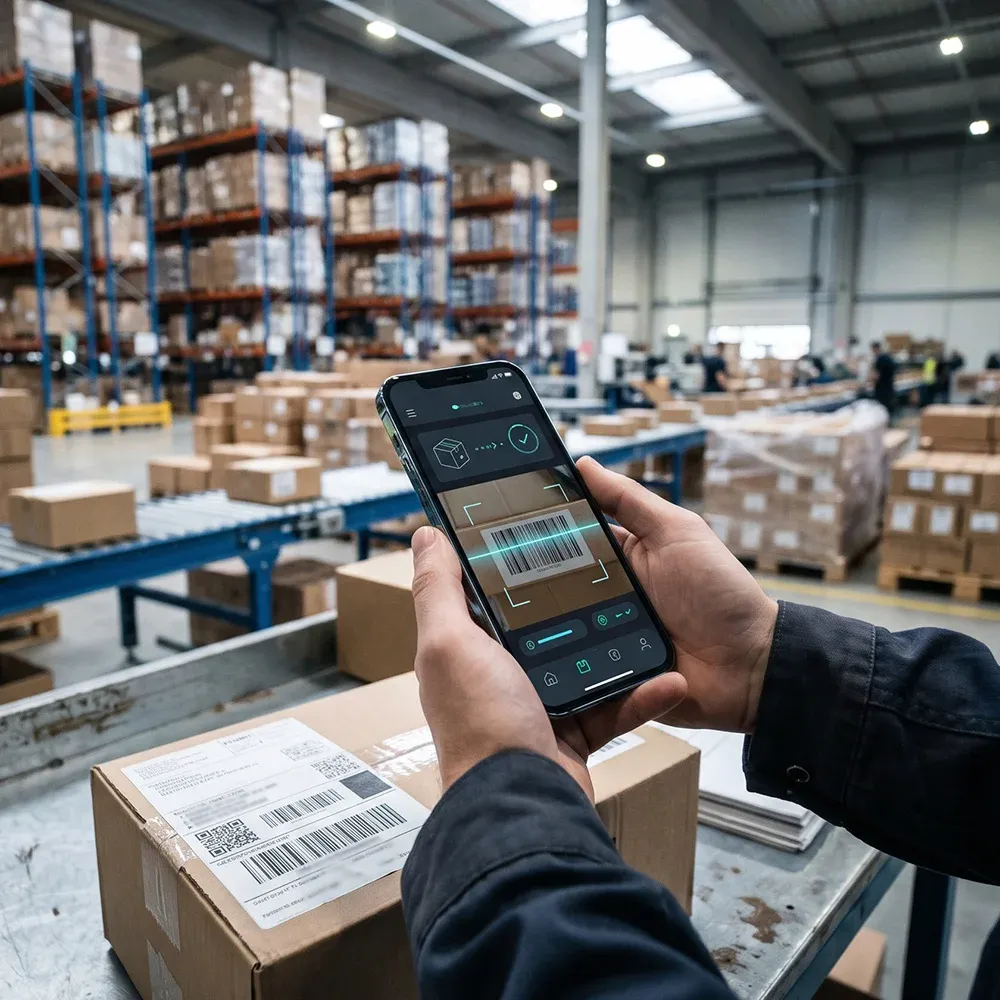
- Everything on a phone. Every warehouse and field task happens on an ordinary phone over Wi-Fi: scanning, inspection, dimensions and weight, photos, racking, manifesting, pickup, delivery and proof of delivery. No scanners, stations or cabling. The phone's camera reads the label, photographs the damage and captures the signature. The admin side, rates, permissions and users, runs on a laptop. The decision to go phone-first came straight from discovery: every station was a place the worker had to walk back to, and every walk was a delay and a chance to forget.
- One record, from arrival to delivery. Charges, including customs duty and the network's profit, calculate automatically at inspection. The customer is notified on their dashboard and by email in the same minute. Payment moves the package to pre-manifest, then manifest. The destination office receives it, racks it to a recorded location, delivers it and records proof of delivery, all on the same phone. The QuickBooks invoice is generated by the system; nobody types it.
- Multi-level by necessity. The system is a warehouse system for Miami and a destination system for each country, because each country's flow turned out to be different: different customs rules, different delivery patterns, different partners. Each partner sees only their own operation. The Miami warehouse sees everything.
- The owner's reporting. This came last and mattered most: what the network pays the airline, the warehouse and vendors, commissions to country agents, and the profit, per package and per country. Before, that number existed only in someone's spreadsheet at the end of the month.
- A public website on Next.js, with customer sign-up, tracking and the dashboard, so the customer side matched the operation behind it.
Launch
Phones in hands, the team trained on the floor, and the paper process running beside the app for the first days so nothing was lost if a step was missed. The arrival scan went live first, because it was the most frequent task and the one that fed everything else. The destination systems came online country by country, and each one taught us something the first had not.
What Changed
- A network with no system had a first version live in three months, the full platform in six, and has run on it since
- More than 4,000 packages a month move through it
- No hardware investment: Wi-Fi and the phones the team already carried
- Spreadsheets are gone from the flow; duty, charges, profit and invoices are calculated and generated by the system
- Island offices have shelving, recorded locations, proof of delivery and a point of sale, on the same phones
- Partners in each country see only their own operation; the Miami warehouse sees everything
- The system was rewired repeatedly in the first months as the real process emerged, and the flow, reporting and speed are now where the client wants them
What We'd Tell Another Founder
The documented process and the real one are never the same. We mapped the service from one country's point of view and learned, only when other countries went live, that each had its own flow. The lesson shaped how we run discovery now: ask more, assume nothing, and keep the design open for what you'll only learn in production.
The second lesson is about hardware. The instinct in a warehouse is to buy scanners. The phone in every worker's pocket already does what a scanner does and three things a scanner can't: photographs, signatures and a screen that shows the next step. Build for the device people already carry.
Thanks to you and your team's efforts, our operation in Miami is going stronger.
Danish gives his all every single day.

Tell Us How Your Operation Runs.
We'll Tell You What to Build.
A free 30-minute consultation with our founder. You leave with a clear view of what to build, what to automate and what to leave alone. No pitch deck. It is the shortest way to find out whether we are the right custom software development company for your operation, and we'll say so either way.
Book a Free ConsultationFive initial discovery calls a week, one a day, 11 AM to 3 PM Eastern.